Online Casino Scams UK 2026: Fake Sites, Clones and Traps
 Rachel Doughty
Updated
The majority of casino scams targeted at UK players are relatively simple. A scammer will create a website, add a fake licence badge, fill it with games and offer bonuses. Once the framework of a legitimate website is in place, scammers can use many different methods to take a player's money. Here are some of the most prevalent methods, how to determine if a site is fraudulent, and what to do if money has already been deposited.
- 338,272URLs the Commission sent to search engines, April 2025 to March 2026
- 266,595of them removed from search results
- 494cease and desist notices sent to illegal operators
- 247notices sent to advertisers and affiliates of illegal sites
Six online casino scams aimed at UK players
Some sites will take a player's money and others will take a player's personal information or charge them a fee to process a refund.
- The fake licence badgeAn unlicensed site shows a Gambling Commission logo or a licence number. The badge is just an image. Only the Commission's register counts.
- The lookalike nameA site one letter away from a licensed brand, or using the name of a brand that has no British licence at all.
- The celebrity advertA famous face "recommends" a casino or game app in a social media ad. Licensed operators cannot use people with strong appeal to under-18s.
- The "verify your account" emailA message asks for your ID or card details through a link. Upload documents only through the casino's own site.
- The scratchcard subscriptionA monthly fee for digital scratchcards, with more cards for signing up friends. The Commission warns this can be an illegal lottery.
- The recovery firmAfter a loss, someone offers to get your money back for an upfront fee. The routes that work, from complaints to dispute services, are free.
 The fake licence badge
 The lookalike name
 The celebrity advert
 The "verify your account" email
 The scratchcard subscription
 The recovery firm
Why familiar games do not make a casino safe
Just because a site offers games that you are familiar with does not mean the site is legitimate.
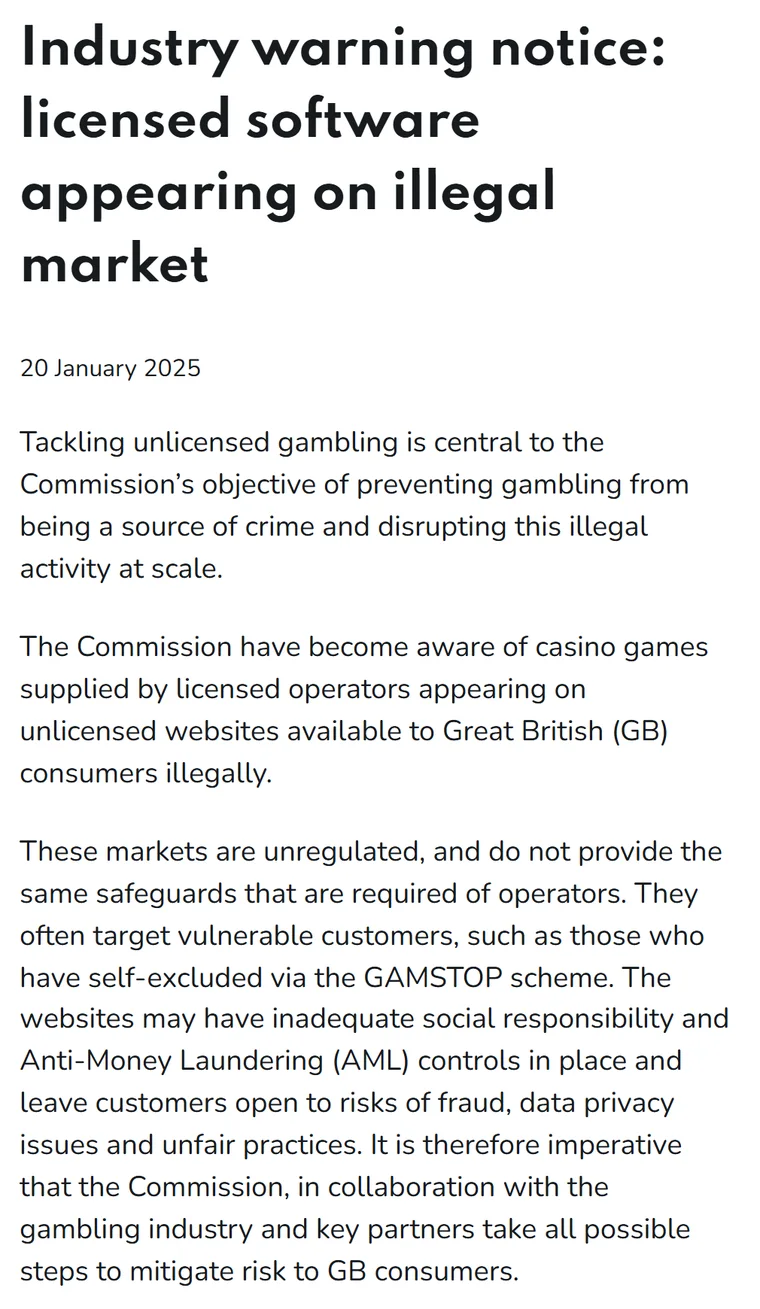
In January 2025 the Commission warned that casino games supplied by licensed companies were turning up on unlicensed websites open to British players. In some cases, resellers were passing the games on in breach of their contracts.
Like the 2025 warning, the Commission has stated that unlicensed operators are using games and other offerings from licensed operators. In some cases, unlicensed operators are using games and offerings from licensed operators to trick self-excluded players into using fraudulent and malicious offerings.
The games are the same. What is missing is everything around them: the complaints route, the dispute service, the ID and age checks, and a regulator that can fine the operator.
How to spot a fake or unlicensed online casino
Each of these is a sign the site is not licensed in Britain. Any one is enough to walk away.
- The domain is not on the register
Search the Commission's register for the company, then check this exact web address is listed as an active domain. A badge on the site is not proof.
- It takes crypto
Casinos licensed in Britain do not permit cryptocurrency transactions. Any ‘UK’ crypto casinos are unlicensed.
- It sells "no verification" or "not on Gamstop"
Each casino is obliged by the law to verify the ID of each customer and be part of Gamstop. Any casino that does not follow this law is operating illegally in the UK.
- The wagering is over 10x
From 19 January 2026, all casinos in the UK are prohibited from offering bonuses with a wagering requirement of more than 10x. Offers with wagering requirements of 35x or 50x should raise concerns regarding the legitimacy of the offer.
- Slots above £5 a spin
Since April 2025, all casinos are required by law to limit the stake for online slot games to £5, and £2 for players under 25. Offering games with stakes higher than this is in violation of the law.
Our article explaining how to check a casino license walks through the register step by step. Additional information regarding the rules regarding bonus and slot stake limits is available on our website.
What you lose at an unlicensed online casino
Playing at an unlicensed casino doesn't violate the law. Playing at unlicensed casinos does not protect you, and in some cases, you may experience problems receiving your funds.
| Protection | Licensed in Britain | Unlicensed |
|---|---|---|
| Complaints | 8 weeks to answer, then a free dispute service such as IBAS | Whatever the site decides |
| Self-exclusion | Must honour Gamstop | No duty to check it |
| Your balance | Funds protection level must be disclosed | No disclosure, no oversight |
| Bonus terms | 10x cap and fair terms rules | Any terms, changed at will |
| If it breaks the rules | The Commission can fine it or suspend its licence | The Commission can try to get it blocked, and in rare cases prosecute |
Our article on protecting consumer funds provides information on consumer funds and ID verification.
How the Commission takes down illegal casino sites
Based on data published by the commission, this shows the websites removed from search engines each quarter.
-
Apr to Jun 202525,431
-
Jul to Sep 202563,530
-
Oct to Dec 2025118,814
-
Jan to Mar 202658,820
-
Apr to Jun 202619,678
In the financial year 2025/2026 the commission sent 338,272 web addresses to search engines to be removed and 266,595 of those requests were granted. The commission also issued 494 cease and desist orders to illegal gambling websites, and 247 orders to advertisers and affiliates of illegal websites.
Taking a site down by getting it removed from search results is not easy, and sites can be accessed via many different links. For casino sites that are legally operating and have their licenses checked, see our safe online casinos in the UK.
What to do if an online casino has scammed you
The faster you act, the greater the chance of stopping the payment.
- 1Stop paying in
Once a site charges you to release your winnings, you should know that you've been scammed.
- 2Call your bank or card provider
Letting them know the site is a scam is in your best interest, and you should keep a copy of all the evidence including the site, your account, and all payments.
- 3Report the fraud
In England and Wales report it to Report Fraud. In Scotland report it to the Police.
- 4Report the site
The Gambling Commission has a secure online form for reporting scams. You can forward scam emails to report phishing attempts and scam texts to 7726.
- 5Ignore anyone offering recovery
Never pay to have your money recovered.
You can file a complaint if a casino does not pay you, but it's not a scam. Learn more about what to do if a casino is not paying you.
Online casino scams: questions
How can I tell if an online casino is fake?
Search the Gambling Commission's register for the company behind the site, and check the exact web address is listed as an active domain. Crypto payments, "no verification", "not on Gamstop" and wagering over 10x are all signs a site is not licensed in Britain.
Is it illegal to play at an unlicensed casino in the UK?
Not for the player. The offence sits with the operator and anyone advertising it. But you lose every protection a licence gives you, from complaints to self-exclusion.
Can I get my money back from a scam casino?
Because these sites are unlicensed, you have no protection and no recourse. Report the fraud to your bank.
Who do I report a scam casino to?
Report the fraud to Report Fraud (0300 123 2040) and to the police in Scotland. The Gambling Commission's confidential website allows you to report a violation.
Are recovery companies legitimate?
Be very careful. Anyone who contacts you after a loss offering to recover money for a fee may be running a second scam. Complaints and dispute services for licensed casinos are free.
Does a Gambling Commission logo on a site mean it is licensed?
Anybody can post a web page with a gaming logo. Only the public register of the Gambling Commission can tell you who is authorized to operate gaming sites.

Rachel Doughty
Editor, Casino Warnings · Bristol
Rachel reads the Gambling Commission's registers and enforcement notices, and the terms casinos publish for British players, then writes them up in plain English.
- Sources
- Gambling Commission industry warning notice of 20 January 2025; its quarterly impact metrics on unlicensed gambling (April 2025 to June 2026); its scams and fraud guidance for players; its blog on tackling unlicensed gambling (October 2024); GOV.UK guidance on reporting scams and phishing; NCSC scam website reporting.